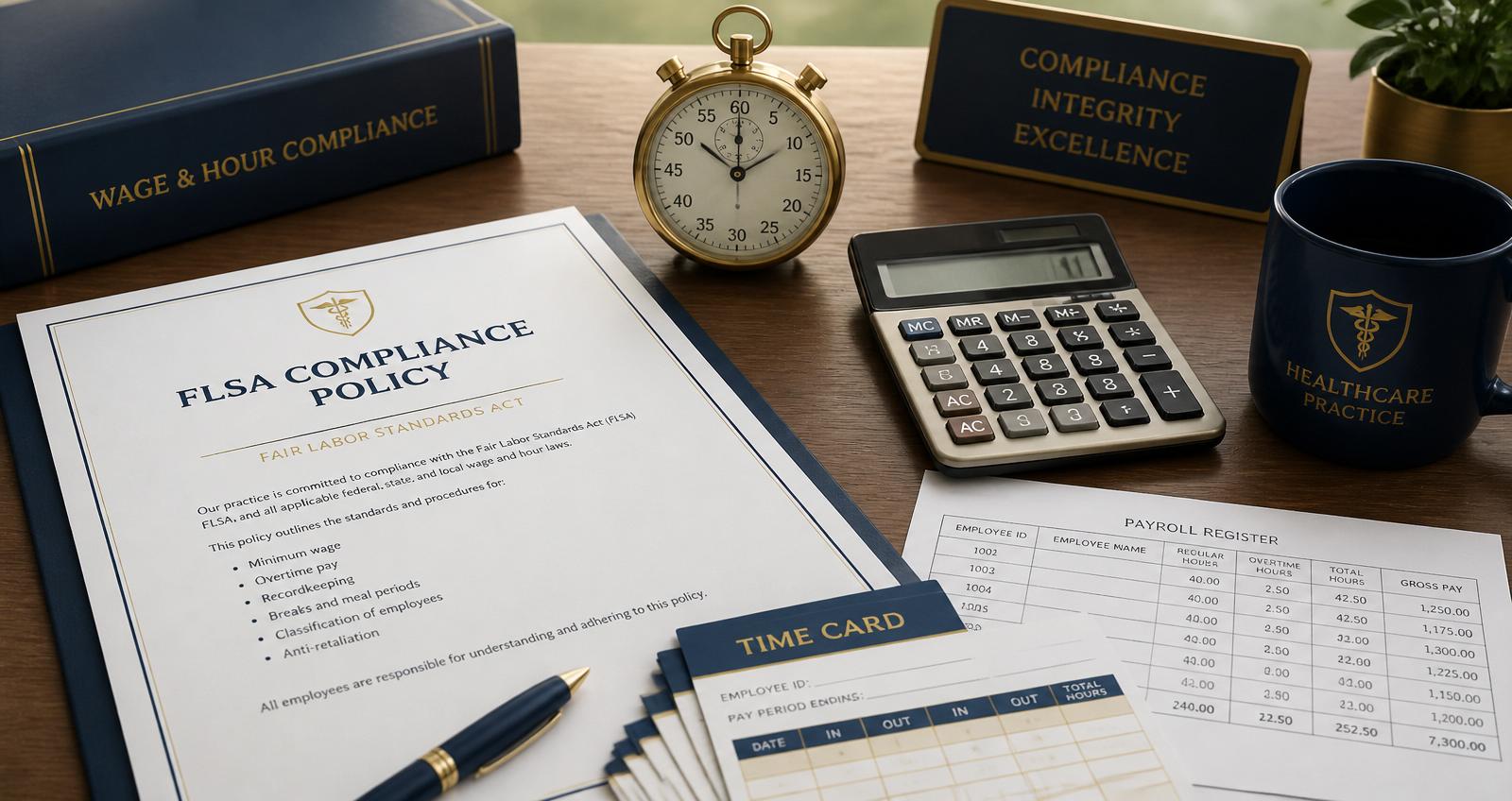
The Double Diagnosis, Applied to Payroll
Every healthcare practice I work with is fluent in one kind of compliance: the clinical kind. Charting standards, licensure renewals, infection control. What catches practice owners off guard is the second diagnosis sitting underneath the first one: employer compliance. Wage and hour law does not care how good your clinical documentation is. It cares whether your front desk coordinator was paid overtime last Thursday, and whether you can prove it.
The Fair Labor Standards Act is the federal law governing minimum wage, overtime, recordkeeping, and youth-employment standards for covered employment. Its reach is broad, but coverage has to be evaluated under either the FLSA's enterprise-coverage rules or its individual-employee coverage rules, not assumed automatically. Healthcare practices are not exempt merely because they are small or employ licensed professionals, and they are not automatically covered just because they have a payroll either. That distinction, between assuming coverage and confirming it, is where I see more wage and hour exposure in small healthcare practices than almost anywhere else.
What FLSA Wage and Hour Rules Actually Require
At its core, the FLSA requires two things for non-exempt employees within covered employment: at least the applicable minimum wage for every hour worked, and overtime pay of one and a half times the regular rate for hours worked beyond 40 in a workweek. It also requires employers to keep specific records documenting hours and pay.
In Florida, employers have to satisfy both the federal floor and the state floor, and the higher one governs. Effective September 30, 2026, Florida's minimum wage for covered employees is $15.00 per hour, up from $14.00. After that, Florida's constitution shifts to an inflation-based system: the first post-$15 adjustment will be calculated on September 30, 2027 using the CPI-W and take effect January 1, 2028, with the same calculation repeating each year after. The federal minimum wage remains $7.25 per hour, so Florida's higher rate generally controls for covered work performed in Florida.
The exemption side of the FLSA is where things get more technical. To be exempt from overtime under the executive, administrative, or professional exemptions, an employee generally has to meet both a salary basis test and a duties test. As of September 30, 2026, the federal salary threshold for these "white collar" exemptions is $684 per week, following a May 2026 DOL technical amendment that unwound the vacated 2024 rule and restored the operative 2019 regulations. The alternative highly compensated employee test requires total annual compensation of at least $107,432, including at least $684 per week paid on a salary or fee basis. High compensation alone is not enough: the employee's primary duty still has to include office or non-manual work, and the employee has to customarily and regularly perform at least one exempt executive, administrative, or professional duty. Because these thresholds have moved twice in recent years, confirm the current amounts before relying on them for a classification decision.
Overtime calculations also have to account for more than base hourly pay. Non-discretionary bonuses, shift differentials, and certain other forms of compensation generally have to be folded into an employee's "regular rate" before the overtime multiplier is applied. A lot of practices calculate overtime off base pay alone and miss this.
One narrow exception is worth naming so it is not misapplied: hospitals and qualifying residential care establishments, which may include certain skilled-nursing and assisted-living facilities, may use a fixed 14-day "8-and-80" overtime system instead of the standard 40-hour workweek, provided there is a prior agreement or understanding with the affected employees. This exception does not automatically extend to physician offices, dental practices, outpatient clinics, or most home care agencies, and not every residential facility automatically qualifies. If your practice includes a residential care component, that is worth confirming with an employment attorney rather than assuming it applies.
Who This Applies To
Many medical practices, dental offices, behavioral health clinics, wellness practices, home health agencies, and home care agencies are subject to the FLSA, but coverage should be confirmed rather than assumed solely from the existence of an employee. Enterprises with at least two employees that operate hospitals or provide medical or nursing care to residents are covered regardless of revenue. Other practices may have enterprise coverage when they have at least two employees and at least $500,000 in annual sales or business, or individual employees may be covered because their work regularly involves interstate commerce, such as handling out-of-state billing, interstate transactions, or communications across state lines. Many established healthcare practices will be covered under one or both routes, but the specific basis should be documented.
Clinical licensure does not, by itself, determine overtime status. Registered nurses licensed by the appropriate state board may generally satisfy the duties component of the learned professional exemption, but they ordinarily must also be paid on a qualifying salary or fee basis before exempt status is even a possibility, and each role should be reviewed on its actual duties. Licensed practical nurses, medical assistants, and similar healthcare employees generally may not qualify for the learned professional exemption, because an advanced specialized academic degree is not typically a standard prerequisite for entry into those occupations, though the specific position should still be reviewed rather than assumed.
Dental hygienists require a more individualized look. Federal regulations indicate that dental hygienists who have completed four academic years of qualifying accredited professional study may generally satisfy the learned professional duties test, which can produce a different outcome than for LPNs or medical assistants, and the individual role should be reviewed. Front desk employees and most home health aides generally remain non-exempt, subject to any narrow and currently applicable domestic service exemption discussed below. Licensed physicians actually practicing medicine are generally treated as a separate category, since the ordinary salary-basis and salary-level requirements may not apply to the medical practitioner exemption. In every one of these cases, the classification should be reviewed against the employee's actual duties and pay arrangement, ideally with employment counsel, rather than treated as settled by job title or license.
Home care and home health agencies have an additional issue to monitor. The current regulations at 29 CFR §§ 552.6 and 552.109 reflect the Department of Labor's 2013 rule, which narrowed the definition of companionship services and generally prevents third-party employers, including home care agencies, from claiming the companionship services and live-in domestic service exemptions. In July 2025, DOL proposed rescinding those provisions, and it also issued Field Assistance Bulletin 2025-4, directing Wage and Hour Division investigators not to apply the 2013 provisions while that rulemaking is pending. That bulletin is an enforcement policy only. It does not amend the regulations, create enforceable rights, or prevent private employees from bringing wage claims under the existing regulatory text. As of September 30, 2026, DOL has not issued a final replacement rule. If your agency relies on either exemption for any caregiver classification, get employment-law advice before treating it as settled.
Where Small Healthcare Practices Get This Wrong
The most common gap I see is the assumption that "licensed" and "exempt" mean the same thing. They do not. A licensed, credentialed employee can still be legally entitled to overtime if their role does not meet the duties test, and paying someone a salary does not automatically remove that obligation either. A related but separate question is whether a worker is an employee at all; our guide Employee or Independent Contractor? Worker Classification for Home Care Agencies in 2026 covers that side.
The second common gap is travel time in home-based care. Ordinary travel from home to a first client and from a last client back home is generally treated as commuting time. Travel from one client or job site to another during the workday is different: under 29 CFR § 785.38, job-site-to-job-site travel generally must be counted as hours worked. In Secretary United States Department of Labor v. Nursing Home Care Management Inc., No. 23-2284 (3d Cir. Jan. 31, 2025), the Third Circuit held that home health aides had to be compensated for the time reasonably necessary to travel between client locations, including necessary travel after an off-duty interval, while personal detours such as going home, running errands, or heading to another job were not compensable beyond the time reasonably necessary to reach the next assigned client. That decision is persuasive rather than binding on Florida employers, since Florida sits in the Eleventh Circuit, not the Third, but it applies the same federal travel-time regulation that governs Florida practices. Agencies that pay per visit or per shift without separately accounting for this travel time are carrying real exposure.
The third gap is off-the-clock documentation time. Time spent completing required charting, EHR entries, or care notes is compensable when the practice knows or has reason to believe the work is being performed, including work completed remotely after a shift ends. A policy prohibiting unauthorized overtime can support corrective action against an employee, but it does not allow the practice to withhold pay for work it knew was actually happening.
The fourth gap is per-visit or per-diem pay models in home care that do not get reconciled against actual hours worked. These models can be lawful, but the practice still has to confirm that total pay divided by total hours meets minimum wage and that overtime is calculated correctly when the total crosses 40 hours in a week.
Documentation Requirements
The FLSA's recordkeeping rules, found at 29 CFR Part 516, require employers to maintain accurate records of hours worked, wages paid, and the basis on which pay is calculated for every non-exempt employee. Core payroll records generally need to be kept for at least three years. Supporting records used to calculate pay, such as time cards, schedules, and wage rate tables, generally need to be kept for at least two years. These are the records a Department of Labor investigator or a plaintiff's attorney will ask for first if a wage claim is ever filed, and the absence of clean records tends to work against the employer, not for it.
For a small healthcare practice, that means a reliable, consistently enforced timekeeping method that captures actual hours worked. The FLSA does not require a specific technology or a punch clock; employees can record their own time, but the employer remains responsible for making sure the records are complete and accurate. Written job descriptions are useful too, though it is worth being clear about what they are: they are not among the basic payroll records required under 29 CFR Part 516, and they do not control a classification outcome by themselves. The employee's actual duties and how they are actually paid control. Someone should also periodically check that bonuses, differentials, and travel time are correctly reflected in overtime calculations, not just base pay.
How to Build a Defensible Wage & Hour System
Start with a classification audit. Go role by role, not department by department, and confirm that each position's actual day-to-day duties support its exempt or non-exempt status. Do not rely on the classification the practice inherited from a prior owner or a template job description.
Put a reliable timekeeping method in place for every non-exempt employee, including home-based staff, and make sure it captures travel time between clients where applicable and any after-hours documentation time. It does not need to be a particular piece of software, but it needs to consistently produce complete, accurate records, and someone needs to actually be responsible for checking that it does.
Build a simple, written policy on how bonuses, differentials, and travel time factor into pay and overtime, and train whoever runs payroll on it. This is usually a payroll mechanics gap, not a bad-faith gap, and it is fixable with a clear procedure.
Review your recordkeeping against the retention periods in 29 CFR Part 516 and confirm your system actually holds records that long and can produce them quickly if requested.
Finally, put classification and pay practices on a recurring review calendar, at minimum annually, because roles evolve, regulations shift (as the current companionship exemption uncertainty shows), and a classification that was defensible two years ago may not be defensible today.
None of this requires guesswork. It requires a system, and building that system is exactly what the HR Triage Assessment is designed to help you start.
Get Clarity on Where You Stand
Wage and hour exposure tends to sit quietly until it does not. A classification audit now is a lot less expensive than a back-pay claim later. If you want a clear, specific read on where your practice's wage and hour practices stand, start with the assessment.
Sources Used for Verification
- U.S. Department of Labor, Fact Sheet #14: Coverage Under the FLSA
- U.S. Department of Labor, Fact Sheet #17N: Nurses and the Part 541 Exemptions
- U.S. Department of Labor, Fact Sheet #17D: Professional Employees
- U.S. Department of Labor, Fact Sheet #17H: Highly Compensated Employees and the Part 541 Exemption
- U.S. Department of Labor, Fact Sheet #54: The Health Care Industry and Calculating Overtime Pay (8-and-80 system)
- U.S. Department of Labor, Fact Sheet #21: Recordkeeping Requirements under the FLSA
- U.S. Department of Labor, WHD news release on technical amendment restoring 2019 salary levels (May 14, 2026)
- U.S. Department of Labor, Fact Sheet #79A: Companionship Services Under the FLSA
- U.S. Department of Labor, Fact Sheet #79B: Live-In Domestic Service Workers Under the FLSA
- U.S. Department of Labor, Application of the FLSA to Direct Care Workers
- Federal Register, Application of the FLSA to Domestic Service (NPRM, July 2, 2025)
- U.S. Department of Labor, Field Assistance Bulletin 2025-4
- eCFR, 29 CFR §§ 552.6 and 552.109 (companionship services)
- eCFR, 29 CFR § 541.301 (learned professionals, including the nurse and dental hygienist provisions)
- eCFR, 29 CFR § 785.38 (travel that is all in the day's work)
- eCFR, 29 CFR Part 516 (Records to Be Kept by Employers)
- Secretary United States Department of Labor v. Nursing Home Care Management Inc., No. 23-2284 (3d Cir. Jan. 31, 2025), precedential opinion
- Florida Constitution, Article X, Section 24 (minimum wage and CPI-W adjustment schedule)
- Florida Department of Commerce, Florida minimum wage guidance